Best Time to Take Diet Pills: Timing That Actually Helps
Quick Answer: What Is the Best Time to Take Diet Pills?
The best time to take diet pills depends on the formula. Appetite and fiber support works best about 30 to 40 minutes before your largest meals with a full glass of water. Energy or stimulant formulas belong in the morning, never late in the day. A stimulant-free supplement is flexible and will not disturb sleep.
- Appetite & fiber: 30–40 minutes pre-meal with plenty of water.
- Energy & stimulants: morning or pre-workout only, never evening.
- Above all: consistency most days beats perfect timing on a few.

Ask ten people the best time to take diet pills and you will get ten answers, most of them confident and several of them wrong — because the honest answer is “it depends on what is in the bottle.” A pre-meal fiber that supports fullness wants to be taken before you eat. A morning energy formula wants daylight hours so it does not steal your sleep. Get the category right and the timing follows logically; get it wrong and you either blunt the benefit or trade your night's rest for it. This guide sorts the categories and gives you a routine you can genuinely keep.
It helps to say the biggest thing first, because it reframes everything below: timing is a minor lever compared with consistency. A dose taken most days at a slightly imperfect hour will out-perform a perfectly timed dose you keep forgetting. So treat the details here as optimization, not obligation — useful polish on a habit whose real value comes from showing up daily.
Match the timing to the formula, not the myth
There is no single “best time” that applies to every product, because diet supplements do different jobs. Broadly, three categories cover the market. Appetite and fiber support aims to make you feel full sooner, so it is timed around meals. Energy and thermogenic formulas lean on stimulants and are timed for daytime and activity. And general metabolic or gut-support formulas are timed mostly for consistency, because their mechanism builds over days and weeks rather than acting on any single meal. Knowing which one you hold answers ninety per cent of the timing question on its own.
The persistent myth worth dismantling is that there is a magic hour that unlocks fat loss. There is not. Timing can make a formula a little more effective and a lot more comfortable, but it cannot substitute for a modest calorie deficit, and no clever schedule turns a supplement into something that diagnoses, treats, cures or prevents anything. Keep that boundary in mind and the advice below stays in its proper, useful place.
Appetite and fiber support: 30 to 40 minutes before meals
If your goal is to eat a little less at your main meals, the logic of pre-meal timing is straightforward. Soluble fiber needs a short head start to take up water and begin promoting a sense of fullness, so taking it roughly 30 to 40 minutes before your largest meal means the satiety is building right as you sit down to eat. Pair it with a full glass of water — both because fiber needs fluid to work comfortably and because the water itself adds to the feeling of fullness.
Which meals? Aim the pre-meal dose at the ones where you tend to overeat — for many people that is dinner, or lunch and dinner. The point is to put the appetite support where your biggest calorie risks are. This same fullness mechanism is the reason a fiber-first approach is a durable way to eat less without feeling deprived, which we unpack in the guide to a natural appetite suppressant that actually works. If cravings rather than portion size are your main challenge, our piece on how to curb cravings naturally pairs neatly with this timing.

Energy and stimulant formulas: morning only
Stimulant-based products are the ones where timing genuinely matters for your wellbeing, not just your results. Caffeine and its relatives have a long half-life, which means a mid-afternoon dose can still be circulating at bedtime, fragmenting your sleep even when you fall asleep fine. That is a real problem for weight management, because short or broken sleep raises the hormones that drive appetite the next day — so a late stimulant can quietly work against you on both ends.
The rule for that category is simple: morning, or before a daytime workout, and never in the late afternoon or evening. If you already drink coffee, count that toward your total and be honest about how much stimulant you are stacking. And if the idea of scheduling your supplement around your sleep sounds like a hassle, that is itself an argument for choosing a formula with no stimulants at all — which removes the entire problem.
Stimulant-free means timing you can't get wrong
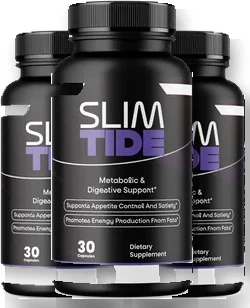
SlimTide is a once-daily, stimulant-free capsule, which makes the timing question refreshingly low-stakes. Take it before your largest meal with water for the appetite benefit, or simply attach it to a daily anchor you never miss — because with no caffeine, there is no wrong hour and no sleep to protect. To see the full label and current pricing before you build it into your routine, check the official page.
With food or on an empty stomach?
This is the other half of the timing question, and again the label decides it. Fat-soluble nutrients and many stimulants sit better when taken with a little food, which buffers the stomach. Some appetite-support fibers, by contrast, are designed to be taken shortly before a meal with water so they can expand and promote fullness before you eat. If a product makes you queasy on an empty stomach, taking it with a small amount of food is a safe default that rarely blunts the benefit — comfort you will actually sustain beats a theoretically optimal dose you dread.
Separating “with food” from “empty stomach” supplements also matters if you take several things. Do not assume every capsule in your morning handful wants the same conditions; a thirty-second glance at each label prevents you from taking a with-food product on an empty stomach and wondering why it disagrees with you.
The best schedule is the one you will still be following in week eight. Optimize for the habit first and the fine details second — a missed dose is always worse than a mistimed one.
A simple timing cheat sheet
Use the table to place whatever you are taking. When a label's instructions differ from the general pattern, the label wins.
| Type | Best time | With food? | Why |
|---|---|---|---|
| Appetite / fiber support | 30–40 min before largest meals | With water, before eating | Fullness builds as you sit down to eat |
| Energy / stimulant burner | Morning or pre-workout | Often with a little food | Avoids sleep disruption and stomach upset |
| Fat-soluble nutrients | With your largest meal | Yes, with fats | Improves absorption |
| Gut / metabolic support (stimulant-free) | Any consistent daily time | Either; with food if sensitive | Mechanism builds over weeks, not one dose |
| Once-daily formulas like SlimTide | Pre-meal, or any anchor you never skip | Water always; food if preferred | No stimulants, so no wrong hour |
How many times a day, and why more is not faster
The dosing frequency is set by the label, not by ambition. Many modern formulas, SlimTide among them, are once-daily by design, which removes most of the timing guesswork and makes the habit far easier to keep. If a product is split into two or three servings, the usual pattern is to space them around your main meals as directed. What does not help is doubling up in the hope of speeding results: taking more than the label states rarely accelerates anything and can increase side effects, which is the opposite of what you want.
Once-daily is quietly a big advantage for adherence. The fewer decisions a routine demands, the more likely you are to keep it, and adherence over weeks is what actually produces results. If you are curious about how that plays out over time, our week-by-week look at how long SlimTide takes to work shows why the daily habit, not the hour on the clock, is the real driver.
How to lock in a routine that survives real life
The best timing advice is worthless if you cannot keep it, so build the dose into something you already do without fail. Attach it to an anchor — brushing your teeth, the first pour of your morning water, sitting down to your usual dinner — so remembering is automatic rather than effortful. Keep the bottle where the anchor happens, not in a cupboard you never open. Set a phone reminder for the first two weeks until the habit is self-sustaining. And if you miss a dose, simply take the next one on schedule; do not double up to compensate, because that trades a harmless miss for a bigger risk of side effects.
Put simply, the winning formula is a good-enough time repeated relentlessly. Take your appetite support before your biggest meal with water when you can, keep any stimulants in the morning if you use them at all, and above everything, do it most days. Consistency is the ingredient no schedule can replace — and it is the one entirely within your control.
Related reading
- The natural appetite suppressant that actually works, and how fullness is built
- How long SlimTide takes to work: a realistic week-by-week timeline
- How to curb cravings naturally between meals
Questions people actually ask
When is the best time to take diet pills?
It depends on the formula. Appetite-support and fiber products work best taken about 30 to 40 minutes before your largest meals with a full glass of water, so fullness is building as you sit down to eat. Energy or stimulant formulas belong in the morning or before a workout, never late in the day. A stimulant-free supplement like SlimTide is flexible because it will not disturb your sleep.
Should I take diet pills with or without food?
Read the label, because it varies by ingredient. Fat-soluble nutrients and many stimulants are gentler taken with food, while some appetite-support fibers are designed to be taken shortly before a meal with water so they can expand and promote fullness. If a product upsets your stomach on an empty stomach, taking it with a small amount of food is a safe default that rarely reduces the benefit.
Can I take a weight loss supplement at night?
If it contains stimulants, no, because caffeine and similar ingredients can wreck your sleep and poor sleep raises appetite the next day. A stimulant-free formula is different: because SlimTide contains no caffeine, an evening dose will not keep you awake, so night-time is fine if that is when you will remember it consistently. Consistency matters more than the exact hour.
How many times a day should I take it?
Follow the label rather than doubling up in hope of faster results. Many modern formulas, SlimTide included, are once-daily, which removes the timing guesswork and makes the habit easier to keep. If a product is split into two or three servings, space them around your main meals as directed. Taking more than the label states does not speed results and can increase side effects.
References
- U.S. FDA — dietary supplements: reading labels and using them safely
- NIH Office of Dietary Supplements — weight-loss supplements, ingredients and cautions
- CDC — sleep, and why stimulants late in the day are counterproductive
- Harvard T.H. Chan School of Public Health — fiber, water and satiety
- PubMed — trials of pre-meal fiber preloads and energy intake
General information, not medical advice. These statements have not been evaluated by the Food and Drug Administration, and no dietary supplement is intended to diagnose, treat, cure or prevent any disease. Speak to a qualified healthcare professional before changing what you take.
See the Official SlimTide Store
Affiliate link. Slimtaide Review Desk earns a commission on purchases made through it, at no extra cost to you. We are not the manufacturer.